Rad Reads – Hamilton Style!

Tuesday, 28 June 2022

Looking to cozy up with a good book? Hamilton authors have served up a bumper crop of local lit that will keep those pandemic blues at bay.

Read this piece in the newly-launced Hamilton City Magazine, whose preview issue is now available! To see what the magazine is all about, and what's forthcoming, click here

Favourite Reads of 2021

Wednesday, 16 February 2022

The pandemic has challenged us all in countless ways and, undoubtedly, changed the way we read. For me, that change has been positive. Though I have fewer moments to read on public transit or listen to audiobooks on my way to work, working from home has allowed me to squeeze in a lot more time to read at home, and audiobooks have been excellent company for neighbourhood walks.

Above, you'll find my favourite books released in 2021, and, below, backlist titles that I think deserve some extra attention. As always (for me), both lists are mostly non-fiction, with a few poetry and fiction titles in the mix. 

In no particular order, here are the books I loved in 2021.

Released in 2021
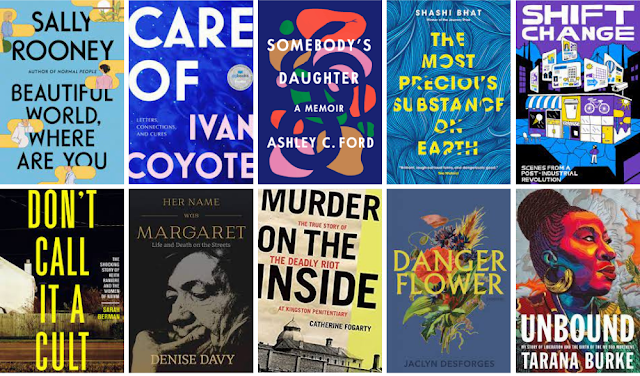
  • Beautiful World, Where Are You by Sally Rooney
  • Care Of by Ivan Coyote
  • Somebody's Daughter: A Memoir by Ashley C. Ford
  • The Most Precious Substance on Earth by Shashi Bhat
  • Shift Change: Scenes from a Post-Industrial Revolution by Stephen Dale
  • Don't Call It a Cult: The Shocking Story of Keith Raniere and the Women of NXIVM by Sarah Berman
  • Her Name was Margaret: Life and Death on the Streets by Denise Davy
  • Murder on the Inside: The Deadly Riot at Kingston Penitentiary by Catherine Fogarty
  • Danger Flower by Jaclyn Desforges
  • Unbound: My Story of Liberation and the Birth of the Me Too Movement by Tarana Burke


Titles Released Prior to 2021
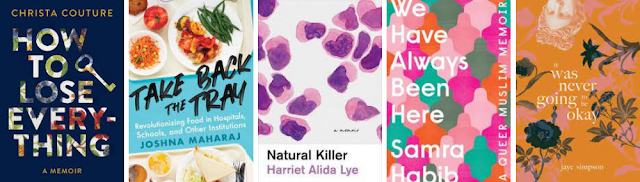
  • How to Lose Everything: A Memoir by Christa Couture
  • Take Back the Tray: Revolutionizing Food in Hospitals, Schools, and Other Institutions by Joshna Maharaj
  • We Have Always Been Here: A Queer Muslim Memoir by Samra Habib
  • it was never going to be okay by jaye simpson

Review: Always Brave, Sometimes Kind by Katie Bickell

Thursday, 4 November 2021

Always Brave, Sometimes Kind
Katie Bickell
Brindle & Glass, 272 pages, $22.00, 2020

The interconnected stories that populate Katie Bickell’s thoughtful debut collection, Always Brave, Sometimes Kind, remind us of how deeply socio-political factors shape our personal experiences. Set in Alberta between 1990 and 2016, the stories explore myriad issues facing Albertans, including boom and bust in the oil industry, the mistreatment of Indigenous communities, labour rights, and addiction. With great warmth and empathy, Bickell’s work captures how the province changed, or didn’t change, over time.

To read this complete review, please visit ROOM Magazine

Favourite Reads of 2020

Thursday, 31 December 2020


My reading habits changed this year, and for the first time, I have audiobooks and eBooks on my list of favourite reads. It's also all non-fiction. As much as I could have used a dose of escapism this year, I seemed drawn to deep dives on important issues. 

So, in no particular order, here are the ten books from 2020 I'd highly recommend. 

Honourable Mentions
Here are a few memorable books I read this year that weren't from 2020. Add them to your list!
(I also read Normal People for a third time. It's a problem.)

Searching for Evidence of Ancestors: Lauren Carter 's Following Sea

Wednesday, 30 December 2020


This review originally appeared in Arc Poetry Magazine

The first poem in Following Sea, Lauren Carter’s second collection of poetry, stands alone, untethered from one of the book’s five sections. Titled “Historian,” it’s set in modern day, a contrast from most of the other 49 poems inhabiting Carter’s meticulous look at family history and human migration.

I find
them: pressed
between pages, those sudden
cursive blooms

she writes in this first piece, searching for evidence of her ancestors’ lives on reels of microfiche and on the pages of worn ledgers.

Centred on the Canadian settler experience of her great-great grandparents, John Willson Chisholm (1823-1900) and Margaret Patterson (1824-1891), Carter crafts a narrative. With finely tuned attention to detail and elegant language, she fills the gaps between dates found on census records and land registers, weaving together family lore, Canadian social history, and genealogical research to imagine their joyful celebrations, gruelling physical labour, and daily burdens. 

Read the full review here

Leftist book world responds to COVID-19

Friday, 19 June 2020

"Historically, pandemics have forced humans to break with the past and imagine their world anew. This one is no different." This quotation by author and activist Arundhati Roy introduces Sick of the System: Why the COVID-19 recovery must be revolutionary, a book of essays released earlier this month as an ebook by Toronto publisher Between the Lines. Available through a pay-what-you-can model, it's just one of the ways Between the Lines has quickly adapted, imagining the publishing world anew.

Canada's coronavirus shutdown began right at one of the busiest times of the year for those in the publishing industry. International spring book fairs, where many book deals are made, operated at limited capacity, were postponed, or cancelled. When COVID-19 forced all non-essential businesses to close, bookstores and libraries were among the first to shut their doors. Book festivals have cancelled or had to quickly navigate unknown digital spaces to move programming online. With fewer opportunities to promote new books and the reduced capacity of printers, many publishers have been forced to delay spring releases.

"It's hard to get a full picture right now," says David Bush, publicity and promotions manager and member of Between the Lines' editorial committee, who expects we'll see how "disruptive" the current climate will be in the coming months. "The world is changing at rapid speed."

To read this full article, visit rabble.ca

Catherine Ocelot's Art Life


This review was originally published in the Hamilton Review of Books

Near the end of Art Life, Montreal-based cartoonist Catherine Ocelot’s introspective and playful graphic novel about her own life as a creator, she asks herself a question many of us could ask ourselves right now: “Should I stop watching TV and do some work?” Seated on her couch, books piled on a table beside her and a steaming beverage in hand, it’s clear that even in her quietest moments, she’s questioning her productivity. In many instances in Art Life, we see that there’s little division between her personal and professional life.

First published in French in 2018 as La Vie d'artiste, and named winner of the Prix Bédélys for best comic in Quebec, Art Life explores the role of artists (and in turn, art) in our contemporary world. In a series of vignettes, Ocelot has conversations with seven of her artist friends, each a storyteller, whether through film, comics, or other media. Together, they explore doubts, disappointments, and observations — some funny, some tragic — connected to living the “Art Life.”

Women: Let's Build our Own Table

From the time we're young, the world tells girls not to take up too much space. Be nice, we're told. Be small. Don't be too loud. Yet, there's another message women and girls of recent generations have been fed on repeat: You can be whatever you want to be. But the road to leadership and achievement is one lined by institutional and systemic barriers. According to No More Nice Girls: Gender, Power, and Why It's Time to Stop Playing By the Rules, a new book by journalist Lauren McKeon, current power structures aren't built for women to succeed.
"Women and others who've been historically excluded from power are more likely to battle gargoyles, to traverse rickety bridges (if there is a bridge at all), to leap over rusty spikes in the road. And god help them if they don't do it all while smiling," writes McKeon, the award-winning writer, editor, and author of the previous book F-Bomb: Dispatches from the War on Feminism. Often called "too nice" for leadership herself, McKeon has written a groundbreaking book that asks women to consider "that if all women are set up to fail, it stands to reason that Indigenous women, women of colour, women with disabilities, homeless and precariously housed women, and those who are LGBTQ+ are only set up to fail more and to fall harder."

To read this full review, visit rabble.ca

Favourite Reads of 2019

Wednesday, 1 January 2020

I'm careful to never call my end-of-the-year list a "Best Of," because as much as I'd like to read all the books, I get through such a small percentage of the books I want to read each year. This is a list of favourites — the books I couldn't put down, the books I highlighted in, and the books I've recommended over all others.

This year's list wasn't easy. There were a lot of good books published in 2019, but I've narrowed them down into a top-ten list that's mostly Canadian and mostly written by women. This year's list is a 50/50 spit between fiction and non-fiction (a departure for me). Read 2018's list, which was dominated by non-fiction.

In no particular order:
Honourable mention (Three books I read in 2019 that weren't published in 2019)
  • Us Conductors by Sean Michaels (for a second time, because it's just so good)
  • Conversations with Friends by Sally Rooney
  • Her by Christa Parravani
  • Suzanne by Anaïs Barbeau-Lavalette

Power and pleasure dominate two new books about women's desire

Tuesday, 24 September 2019

This review originally appeared on rabble.ca. Click here to read the complete review. 
Three Women by Lisa Taddeo
(Simon & Schuster, 2019, 27.00)
Just Pervs by Jess Taylor
(Book*Hug, 2019, 20.00)
Desire can get under our fingernails. It's on our hair and in our eyes, and it sits on our lips with such urgency that at some moments the need to be touched feels like it could break us apart. Yet, in a climate where women prioritizing pleasure is seen as selfish and male fantasies often dictate heterosexual relationships, feeling desire, according to two new books about pleasure and power, breeds shame in many women, leaving it largely unexplored and rarely discussed.
In Three Women, a non-fiction work of reportage by American journalist Lisa Taddeo, and Just Pervs, the bold sophomore collection of short stories by Toronto's Jess Taylor -- pleasure, rather the pursuit of pleasure, is central; however, in so many of the stories told in each remarkable book, power imbalance and the scrutiny of others challenge women's agency over their own sexuality.
The result of eight years of immersive reporting, Three Women is touted as "the deepest nonfiction portrait of desire ever written" and the "riveting true story about the sex lives of three real American women," who shared their stories with Taddeo in person, on the phone, by text message, and email over nearly a decade. There's a familiarity to each woman -- Maggie, Lina, and Sloane; Each is young, white, cisgender, able-bodied and heterosexual. Each has been traumatized, overjoyed, othered and made fragile as a result of her sexual experiences or, in Maggie's case, sexual assault.

Normal People

Tuesday, 27 August 2019

“She closes her eyes. He probably won’t come back, she thinks. Or he will, differently. What they have now they can never have back again. But for her the pain of loneliness will be nothing to the pain that she used to feel, of being unworthy. He brought her goodness like a gift and now it belongs to her. Meanwhile his life opens out before him in all directions at once. They’ve done a lot of good for each other. Really, she thinks, really. People can really change one another.

You should go, she says. I’ll always be here. You know that.” 
― Sally Rooney, Normal People

Have you ever finished a book, and then started it again the second you finished? I hadn't either. Why would anyone do that when there are a thousand other books to be read?

I devoured Normal People and then I devoured it again — the second time with a highligher. (Who does THAT?) and when people ask me why, I don't have an answer. I don't know why Normal People is the book I needed to read at the exact right moment I read it, but it was. And when people ask me what it's about, I can't really explain. What struck me most about it is it's a book about the people who fit in the margins — the people who grow you and change you but never really belong to your life's main narrative. The people who exist between friendships and relationships, but don't fit the definitions of either.

Everyone is talking about Normal People, so I know I'm not alone. But it's special, and it's stayed with me all summer. I keep reading the quotations I've highlighted over and over again. I think I might read it again.

The H-Spot by Jill Filipovic

Thursday, 4 April 2019

Three times I enthusiastically nodded while reading The H-Spot: The Feminist Pursuit of Happiness by Jill Filipovic:

"Looking around at the women I know, there is no question that all of our lives have been shaped, and so many doors opened, by the ability to not get pregnant, or not stay pregnant, when we didn't want to. Our sexual and romantic lives have also been improved by being able to have sex for fun, because we want to, without risking our educational futures, our jobs, our health, or what we wanted in our partners, relationships, and lives."

"Politically, though, we treat sex like it's a vice instead of a normal part of human behavior — a sinful defect but also a consumer product."


Review: Screwed: How Women Are Set Up to Fail at Sex

Monday, 18 March 2019

This review originally appeared on rabble.ca.

"The man screws; the woman is screwed." This is the assertion at the centre of journalist and television host Lili Boisvert's book, Screwed: How Women Are Set Up to Fail at Sex. First released in French Canada as Principe du cumshot, or The Cumshot Principle, Screwed argues that the dominant principle behind heterosexual encounters is that "desire is a male phenomenon and women are merely its object."

In "Me Hunter, You Prey: Passivity as the Cornerstone of Femininity," the first of seven chapters in Screwed, Boisvert explains: "In pornography, the 'cumshot' is the moment when the camera captures a man ejaculating onto a woman’s body or face. It's the final scene, and leaves the actress covered in sperm," she writes. "This image is a perfect representation of the principle underlying a typical heterosexual relationship: in our dominant conception of sexuality, desire originates with a man and is directed upon the woman."

A small book at only 200 pages, Screwed explores the idea that women's lives are dictated by their status as sex objects, and that from girlhood, women are conditioned to be passive.

Click here to read the complete review. 

The Water Cure by Sophie Mackintosh

Monday, 11 February 2019

"I have always been afraid of her ability to pull the rug out from underneath us, her capacity for cruelty and kindness in the same sentence, same action. I can see it in Grace too. It must be a prerequisite for being a mother, something that growing another person inside you does, heart and heartlessness, as though simplistic empathy has been scooped out and replaced with something more fundamental, something more likely to guarantee survival." — The Water Cure

The Guardian called The Water Cure by Sophie Mackintosh "an extraordinary otherworldly debut." Penguin Random House is promoting it as "The Handmaid's Tale meets The Virgin Suicides" (two of my favourite books) and "a dystopic feminist revenge fantasy about three sisters on an isolated island, raised to fear men." How could I not read The Water Cure? How could we not all read The Water Cure with all that is going on right now in the world?

In The Water Cure, "King has tenderly staked out a territory for his wife and three daughters: Grace, Lia, and Sky. He has laid the barbed wire; he has anchored the buoys in the water; he has marked out a clear message: Do not enter. Or, viewed from another angle: Not safe to leave. Here women are protected from the chaos and violence of men on the mainland. The cultlike rituals and therapies they endure fortify them against the spreading toxicity of a degrading world."

Shortly after King disappears suddenly, two men and and a boy appear, challenging all Grace, Lia, and Sky have known about the world they've been guarded from. The result is a tense and unsettling book not only about how unsafe and inhospitable the world can be for women, but also, at its core, it's about womanhood, girlhood, and sisterhood set against Mackintosh's strange, carefully crafted world.

Review: Putuguq & Kublu and the Qalupalik!

Wednesday, 16 January 2019
Something lurks beneath the sea ice of Arviq Bay. That is, if siblings Putuguq and Kublu believe their grandfather’s tale of creatures, called qalupaliit, who snatch unsuspecting children playing too close to the water.

Published by Inhabit Media, an Inuit-owned publishing company that preserves and promotes the stories and knowledge of northern Canada, Putuguq & Kublu and the Qalupalik! is the second graphic novel in a series. The first installment, Putuguq & Kublu, was included in the United States Board on Books for Young People’s Outstanding International Books List.

Read my full review at Quill and Quire.

Summer Cannibals at the Hamilton Review of Books

In case you missed it, check out my latest review — Summer Cannibals by Melanie Hobson — over at the Hamilton Review of Books. 

Favourite Reads from 2018

Monday, 31 December 2018

It was all about non-fiction for me this year, especially books written by women about women, with one hell of an amazing rock memoir thrown in. Here they are in no particular order.

Shrewed by Elizabeth Renzetti
House of Anansi

"The world would be a better place if women had more say in the running of things. At the very least it would be less fucked up."

Read my review of Shrewed at the Hamilton Review of Books. Here's a small snippet of it:
Shrewed: A Wry and Closely Observed Look at the Lives of Women and Girls by Globe and Mail columnist and award-winning novelist Elizabeth Renzetti is dedicated to “my mother, the light at one end of the tunnel, and my children, the light at the other.” This affectionate tribute is a fitting introduction to a fierce and insightful collection of essays that draws on the heartbreaking injustices women have faced in the past, while looking toward a future that only sometimes looks bright. 
In nearly thirty years as a journalist, Renzetti has written about the challenges, failures, and triumphs of the women she has profiled. This, of course, doesn’t make her an expert on all women, and in Shrewed, she’s careful not to make generalizations, noting the diversity of women’s experiences, especially among those in marginalized communities. However, as a woman in a male-dominated field, Renzetti has amassed insight into the many barriers women face in the workplace, in politics, online, and in the streets, forcing her to ask herself why and how the world is so inhospitable to women.
The Measure of My Powers by Jackie Kai Ellis
Appetite By Random House

"I was observant and careful not to be a burden. So from the time I began to speak, I also learned how not to."

I don't love cookbooks because they seem to require action out of me, and cooking isn't near the top of my list of favourite pastimes; however, one thing I love is a food memoir, in particularly if a food memoir is also a travel memoir, as is the case of The Measure of My Powers by Jackie Kai Ellis, a raw and intimate book about how food, travel, and life in the kitchen helped the author find "peace, comfort, and acceptance."

Refuse: CanLit in Ruins edited by Hannah McGregor, Julie Rak, and Erin Wunker
Book*Hug

"What is it to refuse? To say no, but also to say yes to something else, to blow up, to fire up."

Injustice in CanLit is nothing new, but for the first time, there's a powerful collection of essays, with contributions from some of Canada's best emerging writers, that "provides a critical and historical context to help readers understand conversations now happening about CanLit." It's a crucial read for those of us who are active participants within what's referred to as CanLit and those unaware.

Let's Go (So We Can Get Back) by Jeff Tweedy
Faber & Faber

"Every once in a while, somebody would open the backstage door for a precious few seconds, and we'd catch a glimpse of the band onstage, silhouetted by smoke, green-and-purple lit black leather jackets, guitar necks, and cymbals. The music would burst out like a sonic boom, catching us by surprise, sometimes literally knocking us backward. And then the door would slam shut again. But for at least a couple of seconds, we were part of it, enthralled just to be there, grateful for even a few stolen notes."

This blog started with a Wilco lyric ("You are not my typewriter, but you could be my demon, moving forward through the flaming doors." — "War on War" by Wilco) so it will be no surprise that Jeff Tweedy's memoir, Let's Go (So We Can Get Back) was my most anticipated book of the year, and damn it delivered. With a few dozen Wilco/Jeff Tweedy shows under my belt, I loved reading more about how the band came to be and how it's survived/thrived, but it was Tweedy's descriptions of loving and devouring records and concerts at an early age that stuck with me most.

Meg, Jo, Beth, Amy: The Story of Little Women and Why It Still Matters by Anne Boyd Rioux
W.W. Norton and Co. 

"As a book that celebrated the events in young girls' lives and made them as interesting as any adventures on the high seas, Little Women made literature accessible and gave girls the idea that their lives were worth writing about."

It's been years since I've read Little Women, and I will revisit it soon, especially feeling equipped with the historical and cultural context provided by Anne Boyd Rioux's exceptional book, Meg, Jo, Beth, Amy, which not only explores why Little Women still matters today, but also how it has moved generations of women, in particularly women writers. It's a wonderful book for all of us who ever dreamed of becoming Jo.

Dead Girls by Alice Bolin
William Morrow (Harper Collins)

"Like other writers before me, I have tried to make something about women from stories that were always and only about men."

Exploring the "dead girl" trope, so common in pop culture, from Twin Peaks to crime novels, Alice Bolin delivers an absorbing and insightful collection of essays "illuminating the widespread obsession with women who are abused, killed, and disenfranchised, and whose bodies (dead or alive) are used as props to bolster men's stories."

I'm Afraid of Men by Vivek Shraya
Penguin Random House

"What if you were to challenge yourself every time you feel afraid of me — and all of us who are pushing against gendered expectations and restrictions? What if you cherished us as archetypes of realized potential? What if you were to surrender to sublime possibility — yours and mine? Might you then free me at last of my fear, and of your own?"

Vivek Shraya's I'm Afraid of Men might physically be a very small book at less than one hundred pages, however, Shraya's exploration of "how masculinity was imposed on her as a boy and continues to haunt her as a girl" are weighty and raw. This is one of those books that we must all read.

The Real Lolita: The Kidnapping of Sally Horner and the Novel That Scandalized the World
by Sarah Weinman
HarperCollins

"What drove me then and galls me now is that Sally's abduction defined her entire short life. She never had a chance to grow up, pursue a career, marry, have children, grow old, be happy."

I was reluctant to pick this book up thinking it might be just another true crime book about a "dead girl" (Note, this was the book I read just after Dead Girls by Alice Bolin). However, it seemed to keep taunting me on social media, and within minutes of reading the first page, I was hooked. What surprises me most about The Real Lolita is Weinman's ability to create a captivating historical narrative with so little evidence — tracing the experiences of a little girl mostly forgotten to history and an illusive captor who so often changed his name and identity to escape discovery.
Review: Summer Cannibals

Monday, 3 December 2018
This review originally appeared at The Hamilton Review of Books.

Stately homes that shelter family secrets have long been familiar in literature. With creaky floorboards and winding corridors, some dwellings become characters with personalities independent of their inhabitants. However, when thinking of such settings, one might think first of Misselthwaite Manor or Jay Gatsby’s West Egg mansion. Less often we think of a home in our very own city.

Perched atop the Niagara escarpment and weathered by years of neglect, the three-storey home in Melanie Hobson’s debut novel, Summer Cannibals, has three floors, two staircases, seven bedrooms, a coach house, a library, a butler’s pantry, and many secrets. While David and Margaret Blackford, the husband and wife who live inside the house, are fictional, the house itself is not — it is created in the likeness “with a few embellishments” of Hobson’s childhood home on Hamilton’s mountain brow.

It’s to this Georgian-style mansion, owned by the Blackford family for more than 30 years, that David and Margaret’s three adult daughters — Georgina (known as George), Jacqueline (Jax), and Philippa (Pippa) — are summoned. Pippa, the youngest, is pregnant with her fifth child, having left her husband and children behind in New Zealand. She is unwell, and her sisters plan to tend to her, but very quickly, readers discover that Pippa isn’t the only Blackford sister desperate for an escape. The result is a dark, twisted tale of long-buried secrets, unquenchable lust, vengeance, and greed.

Click here to read the complete review.

Review: Wages for Housework

Monday, 12 November 2018
This review originally appeared on rabble.ca.

Wages for Housework: A History of an International Feminist Movement, 1972–77
By Louise Toupin; Translated by Käthe Roth

In order to understand the context in which Wages for Housework — a global feminist movement organized around the idea that domestic (or reproductive labour) was as "crucial for the survival of the capitalist system as more typically male 'productive’ labour'" — was born, one must consider or recall what it was like to be a woman in the 1970s.

In the first chapter of her ambitious book Wages for Housework: A History of an International Feminist Movement, 1972–77, feminist writer and retired university professor Louise Toupin provides a glimpse into daily life for women in the early 1970s — a time in which housework (also called domestic work or care work) was not considered to be real work, rather it was a "labour of love," or a biological duty imposed almost always upon women.

"In Quebec, for example, women could not serve on juries, and civil marriage and divorce had just been legalized, as had homosexuality 'between consenting adults,'" writes Toupin. She adds that access to abortions was only in the process of being liberalized, advertising of contraceptive methods was illegal, and "pay equity was an illusion." At the turn of the 1970s, "very few books dealt with the question of women as a political issue," and scholarly feminist studies were at their earliest stages.

Born in this climate, Wages for Housework saw the absence of earned wages as oppression, and waged men as the oppressors, giving women little, or no, bargaining power to negotiate their own conditions of work. "In reality, a wage is much more than money. It must be understood, in political terms, as a power relationship that structures society," writes Toupin.

Chronicling the Wages for Housework movement from its beginnings emerging from the International Feminist Collective in Italy in the early 1970s, Wages for Housework is divided into two parts — "The International Feminist Collective: Historical Overview and Political Perspective" and "Mobilizations around Women’s Invisible Work." It is the first international history of the Wages for Housework movement, which is much overlooked in the history of second-wave Western feminism.

Click here to read the rest of the review.
 
Designed with ♥ by Nudge Media Design